Monday, November 19, 2012

Of Mirages and Mirrors: The Bolivian Salar de Uyuni

 After several frustrated attempts, last October I finally travelled to Bolivia to see the fabled Salar de Uyuni. I was extremely lucky to have the company of two very good friends eager for a different experience and curious about off-the-beaten-track destinations. Salar means a salt flat in Spanish. The Salar Uyuni is one of these remote and hard to reach mythical places frequently used as the backdrop for adventure and science fiction movies. Uyuni is located on the Altiplano (plateau) in the south-west corner of Bolivia. It covers an area of 12,000 sq. kilometers (6,575 sq. miles) at 3,668 m above sea level between two chains of volcanoes, the Andean Cordillera. It contains more than 10 billion tons of salt, and 50 to 70 % of the world’s lithium reserves. Lithium is a much sought-after mineral widely used in computers, cell phones and electric car batteries.

  IMG_1357ter


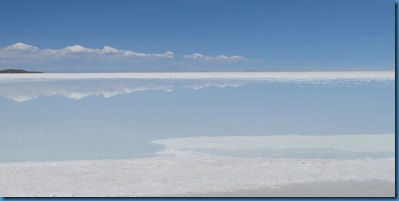
The Salar is renowned for its dazzling and surreal whiteness and changing appearance from mirage to mirror. The salt flat often appears to be a mirage and confuses visitors as its horizon disappears in the hazy sky. It can also be mistaken for an ice surface. A couple of months a year, usually in January and February when rain falls on the Salar, a thin film of water replaces the mirage with a mirror where the surrounding volcanoes reflect their mighty bodies. During the rainy season the cloudy sky reflects on the water. Hence the reflective surface of the Salar has been dubbed “heaven on earth”.
IMG_1436bis


Our twelve-day trip started in Sucre, the colonial capital of Bolivia (now constitutional capital, an honorary title). This small city stands at the civilized altitude of 2,750 m above sea level (9,000 ft.). We also visited Potosi, the highest city in the world at an altitude of 4100 m (13,500 ft.) and the former world capital of silver mining. Purposely we avoided starting the trip in the capital La Paz (altitude 3600 m) as we wanted to be gradually acclimated to the altitude. We ended our expedition in the village of San Pedro de Atacama in northern Chile. We drove some 1,000 kilometers with our guide and driver in a reliable four-wheel-drive Toyota.

The Salar de Uyuni may be unfamiliar to most people in our baby boomer age group. It is much better known to the Facebook generation. In Latin America, Uyuni is first and foremost the backpackers’ destination of choice. Until very recently, access to the Salar was a rough experience even for budget conscious travelers, as hotels were few and far between; moreover since there are no paved roads to speak of one has to make do with the rustic comfort of a four-wheel-drive vehicle and the usually sporty driving of its owner. Although more comfortable hotels are now being built, Uyuni is still not on the itinerary of the “five star” travelers. Total immersion in the Uyuni spirit is not complete unless the traveler sleeps in a hotel room built with salt blocks. In our upscale hotel even the bedside tables were made of salt. We wanted to travel in relative comfort and peace of mind. We had to organize our own circuit and book hotels, and our guide and driver through a reliable travel agency. Self-driving is still neither advisable on the Salar or on the dirt tracks to San Pedro de Atacama. Tracks are unsigned and known only to the local taxi drivers. The city of Uyuni counts some 200 four-wheel-drive taxi companies that take budget travelers from the Salar to the Chilean border where they are met by Chilean taxis for the drive to San Pedro. Bolivian rented cars and 4X4 taxis are not allowed into Chile.

Before traveling to the Salar I could not resist surfing the web to read about other travelers’ experiences. Posted pictures are extremely beautiful and texts are wildly enthusiastic. When in situ I found the Salar de Uyuni still more mesmerizing than its pictures. One feels both humbled and overwhelmed by its white emptiness (it is bigger than Lake Tahoe in Nevada, USA), its quietness and bareness. The Salar is so pure and so unspoiled that it makes the visitor feel free and light. The clean fresh air is invigorating, but deceptively so: at over 4000 m altitude one often feels short of breath. Even if the contrast between the white expanse and the brownish bulky volcanoes is overpowering, it doesn’t seem threatening. A metaphor for this sensation of tranquility is the sight of groups of usually skittish vicuñas grazing unhurried by the road side. Part and parcel of the Uyuni experience is the visit to the Eduardo Avaroa National Andean Wildlife Reserve which is located 150 kilometers south of the Salar towards the Chilean and Argentinian borders. On route, one climbs over 4000 m above sea level and drives on the red and ocher volcanic ash desert of Siloli. The desolate landscape is strewn with oddly shaped rock outcrops as if tossed by surrealist artist Salvator Dali.

                         IMG_1499bis


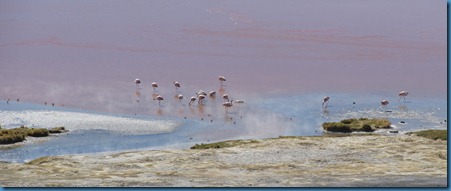
This region is a world of nature superlatives, volcanoes with multicolored sunken craters, geothermal springs and geysers, multicolored brine lakes and glacial salt lagoons. The stillness of this lunar landscape is only broken by the fluttering noise made by the flapping wings of the flamingos. One of the three Andean species of flamingos, the rare James flamingos nest in these lagoons. Herds of graceful vicuñas are everywhere to be seen grazing on the scarce grass.
                       IMG_1507ter


In addition to nature lovers and young backpackers, Uyuni also attracts “Wild West” middle-aged mythology buffs. Their pilgrimage starts some 20 kilometers east of the city of Uyuni at the Pulacayo mining ghost town. From the 18th century until the mid-20th century it was one of the richest silver mines in the world. So rich that its owner built a railway line to ship the ore all the way to the Pacific port of Antofagasta. The mine may eventually resume operations as its new owner, a Canadian company has identified economic silver reserves. Nowadays the mine’s claim to fame is the display of a bullet ridden railway car which was allegedly attacked and robbed by American outlaws Butch Cassidy and the Sundance Kid during their Bolivian exile in 1906-08.

There is credible evidence that the two robbers met their deaths in November 1908 some 100 kilometers south of Uyuni in the small mining pueblo of San Vicente. After robbing a mule train carrying the payroll of the rich Aramayo silver mine, Butch and Sundance took a rest in San Vicente. Soon they were circled by Bolivian soldiers, and after a shoot-out, two bodies were recovered. They were anonymously buried in the international section of the tiny cemetery of San Vicente between the graves of a German miner who had mishandled a stick of dynamite and that of a Swede who could not ride a mule. However reality and fiction are blurred. The outlaws’ families claimed that they moved back to the United States and died there in their beds. The DNA analysis carried out on bodies exhumed in San Vicente were inconclusive as well as those carried out in the USA. In 2011, an international film titled Blackthorn was shot around Uyuni. It tells the story of an aged Butch Cassidy living in Bolivia under an assumed name (Blackthorn) but who decides to return to the USA. The fate of the two famous outlaws will certainly continue to generate investigations and feed local business.

Lonely Planet has just issued its “top 10 best value destinations” for 2013. Surprisingly expensive Rio de Janeiro came first (the advice is go now because the city will get even more expensive after the Soccer World Cup in 2014!). Bolivia ranks fifth and the Salar de Uyuni is listed as a “must-visit”. Therefore don’t wait.

http://www.youtube.com/watch?v=V0biZIJoRpg
http://www.youtube.com/watch?v=pod0UstxMUM


Monday, October 8, 2012

My Summer Readings: Many Shades of Grey


Summer of 2012 in the south of France was both very busy and very social.  As a result, I only managed to read three books which coincidentally covered the most dreadful period of the 20th century, namely the rise of fascism in Europe and WW II.  As illustrated by these three books, the history of this period cannot be seen in black and white.  Major events took place in a more sinister grey zone with many shades of grey.  Fifty shades of grey would be an understatement, or like comparing the “Divine Marquis” with Erika. L. James!

Two of the books are in English: And The Show Went On by Alan Riding and The Lady in Gold by Anne-Marie O’Connor; the third is a French translation of an Italian novel Canale Mussolini by Antonio Pennacchi.  They are all recent releases.

Canale Mussolini pleased me the least.  Its length, over 500 pages, was obviously an inconvenience for summer reading.  Halfway through the book I was tempted to drop it.  Not that the book is badly written, although Pennacchi uses a very colloquial style and vernacular that often made me wince.  His Italian text is peppered with the Veneto region dialect.  Consequently in the French translation the choice of words is odd, if not confusing.  

Canale Mussolini is the thirty-year saga of a family named Peruzzi of mainly illiterate peasants from the Veneto region during the rise and fall of Italian fascism.  Thanks to the family’s close relationship to Il Duce, Benito Mussolini, the seventeen-member family is relocated and given land in the Agro Pontino region near Rome.  Although the region was left in ruins after the Allied landing in 1944, the drainage and colonization of the malaria infested Pontine Marshes is still regarded as one of the lasting social contributions of Mussolini’s dictatorship. 

What makes the second half of the book so fascinating is the politically incorrect manner that the author describes Il Duce, his fascist movement and its followers the so-called “black shirts”, including the male characters of the Peruzzi family.  At the beginning of fascism, the black shirt militia, camicie nere or squadristi, were former disgruntled WWI veterans.  In portraying fascist Italy, Pennacchi takes no prisoners.  He is irreverent and handles self-mockery and self-deprecation with gusto.  It is laughable that most of the Italian fascists were former Socialists and Communists, in that they emulated their Duce who started his political career as a communist.  It is somewhat ironical to learn that Pennacchi did the reverse process:  fascist as a young man, leftist as an older one. 

The book’s nuggets consist of little known but highly pertinent historic anecdotes of the Benito Mussolini era, his rise and fall.  The book is an ode to the resilience of the Peruzzi family, the embodiment of the Italian underprivileged.  The book has not yet been translated into English; it will be a challenging task for any translator.

The sub-title of Alan Riding’s book And the Show Went On is Cultural life in Nazi-occupied Paris (1940-44).  Actually this very comprehensive book describes the cultural life beyond Paris and before 1940.  In May 2012 Alan Riding visited Rio de Janeiro to promote the Portuguese translation of the book.  The book has also been translated into French.  Riding was born in Brazil of British parents and spent many years as a journalist in Latin America.  He also spent decades in Western Europe as the New York Times cultural correspondent.  This experience led him to research the role, behavior and reaction of artists, literati and intellectuals when confronted by oppressive dictatorships.  I was lucky to meet Riding personally before a book signing and his debate with famous free-spirited Brazilian celebrity Fernando Gabeira. 

Gabeira is a “green” politician, author and journalist whose fame however doesn’t derive from his current worthy activities.  During the Brazilian military dictatorship (1964-1985) Gabeira was a student involved in anti-military activities.   One of his faits d’arme was his role in the kidnapping of the United States ambassador in 1969.  As a result Gabeira is still persona non grata in the U.S.A.  More recently, he made headlines when parading on Ipanema beach only wearing a minuscule knitted swimming costume. Rumor had it that it was the bottom part of his girlfriend’s bikini.  Gabeira also ran for mayor of Rio de Janeiro and narrowly lost to the current mayor.

The impact of dictatorship on cultural life and on the activities and production of artists and intellectuals was the topics of the Riding-Gabeira debate.  Comparisons between situations in France and Brazil were made.  At the outset, it is worth pointing out that as the result of its military debacle and defeat, France was forcibly occupied by a dictatorial foreign country.  Dictatorships in 20th century Latin American were self-imposed and did not involve foreign occupation.  

During the four-year Nazi occupation (by the German armed forces and paramilitary groups like the Gestapo) French life was not painted in black and white but in many shades of grey similar to the Italy of Antonio Pennacchi.  In the French artistic microcosm, heroes were few and far between.  If some artists and literati were primarily concerned with their daily survival, others grabbed the opportunity to improve their lots through fraternization or blatant collaboration.  Some of these literati took the opportunity of the occupation to intensify their personal feuds, not to mention those French writers and thinkers who fell over themselves to do the bidding of the occupying forces.  As Jews were obliged to either flee or go underground, opportunists advanced their career by taking their jobs as part of the French-driven Aryanization policy.  For some actors the occupation was a bonus, they welcomed the larger audience.  Were not Germans keen theatre and movies goers?  Cultural production continued in spite of censorship imposed by both German and Vichy governments.  According to Riding, German censors were often more open-minded than their French counterparts!

Riding may not have unearthed new facts, but he has enriched the topic.  His exhaustive compilation and the profusion of noteworthy anecdotes make this compact reading crowded with hundreds of characters very captivating.  In Riding’s account, cultural life in Paris covers a very broad field from prostitution to philosophy; one wonders which was more favored by the occupying forces!   Riding discloses that Hitler had some respect for French culture and that some of his underlings in the cultural area often turned a blind eye on subtle forms of resistance and even developed lasting friendships with their French peers.  Riding reveals that at the end of the war when things were going badly for them, German officers even went to the Comédie française to watch a five-hour long play titled Le soulier de satin (in French) by Paul Claudel.  Had they been punished? Hardly the ideal Rest and Recuperation program in Gay Paris!  Too long, the play is rarely featured. 

Alan Riding does not pass judgment on the behavior of the French cultural celebrities and he quotes the late former British Prime Minister Sir Anthony Eden who claimed that those who have never gone through foreign occupation “have no right to pronounce upon what a country does which has been through all that”.  At the end of his book Riding ponders on the role of “those engaged in artistic and intellectual creation” as they propagate doctrines which may lead to extremism.  On this subject, one should highlight that Germany, Spain and Italy underwent far more radical and dramatic mayhem than France and without the contribution of renowned intellectuals.  While the influential intellectual glitterati were chatting, writing, acting and painting in Paris or Nice, the liberation of France was carried out by others who were less wordy but more action-oriented.  Instead of being in the driver’s seat, the French cultural elite was a mere spectator of its own deliverance.

My last read was Anne-Marie O’Connor’s riveting story of Gustav Klimt’s portrait of Vienna Belle Epoque socialite Adele Bloch-Bauer (1881-1925), the now world famous The Lady in Gold.  It is somehow upsetting to discover that the portrait painted in 1907 became known by a name coined by the Nazis in order to hide the Jewishness of the sitter.  O’Connor is also a journalist; she was a foreign correspondent for Reuters and currently writes for the Washington Post.  Her non-fiction book is as dazzling as the Klimt painting itself, and reads like a novel.  It oozes feminine empathy and thanks to O’Connor’s exhaustive research, the reader becomes bonded to the many hapless characters in the book.  The book received so many complimentary reviews that there is nothing more to add.  It can appeal to an eclectic lot: art lovers, feminists, 20thcentury Mitteleuropa history buffs, readers interested in the Holocaust, and more surprisingly, lawyers familiar with international litigation.

Except for a chapter devoted to Klimt, the book is about the women of the Bloch-Bauer family: Adele the rebel and pre-feminist, her straight-lace sister Luise and her nieces gentle Maria and plucky Nelly.  The most fascinating section of the book covers Nazi Austria from the rather welcome German annexation in 1938 (Anschluss) to the defeat in 1945.  Jewish families were the first targets of the Nazis’ feral anti-Semitism; rich families like that of Adele lost everything but at least managed to save their life. 

The last part of the book describes the twists and turns of the recovery of the Bloch-Bauer art looted by the Nazis and exhibited in Austrian museums.  I found this section much less inspiring.  Maria teamed up with a West Coast lawyer who also had an axe to grind with the Austrian government.  The lawyer, Randol Schoenberg, is coincidently the scion of another Viennese glitterati, composer Arnold Schoenberg who was Adele’s contemporary.  Finally in 2006 after a protracted legal battle, five Klimt paintings, all property of the Bloch-Bauer family were removed from the Belvedere Museum in Vienna and shipped to the United States where Maria and other heirs live.  

When I finished the book I had more questions than answers.  Adele’s Lady in Gold portrait (Klimt painted another one for her) was privately purchased for the exorbitant price of US$135 million by philanthropist and art collector Ronald Lauder, son of Estée Lauder, the founder of the cosmetic empire.  Why did he pay so much money?  Art pundits believe that Lauder needed a significant piece of art to boost ticket sale at his boutique museum, the Neue Gallery in New York City on the Upper East Side.  The other four paintings were soon after auctioned off to anonymous art collectors and are not visible to the public.  The sale of the five Klimt paintings grossed US$327 million divided between the heirs; understandingly Mr. Schoenberg got the lion share of the proceeds (40%).  .

In the mid-90s, I visited the Belvedere Museum and strolling through its collections I admired the Lady in Gold portrait which I compared to a fin de siècle Theodora from the famous Ravenna mosaics Klimt used as a source of inspiration.  I had no clue who sat for the portrait.  When writing this blog, I Googled “Adele Bloch-Bauer” and found pictures of the portrait not the biography of Adele.  The painting has upstaged its sitter.

Last but not least, rumor has it that Adele and Klimt had been lovers.  Klimt was a well-known serial lover, bordering on promiscuity.  Someone may one day write a trilogy about their affair. Title any one? Fifty Shades of Klimt? Or possibly Fifty Shades of Gold?


Wednesday, August 8, 2012

Washington DC: Memorial Overdose and Headaches

  If its dysfunctional Congress makes headlines, it is its monuments that turn the American capital into a tourist draw. As a result, Washington DC has morphed into a shrine to Americana. Year round, museums to anything and memorials to anybody are attracting hordes of curious visitors. With over twenty memorials (of questionable architectural value) and counting, the city is facing a situation of memorial overkill.

As the dust settles over the controversial architecture and design of the Martin Luther King Memorial, a new memorial project is creating waves, offending families, upsetting the architectural world, and distracting the government. If one of America’s greatest sons deserved a memorial it must be Dwight D. (Ike) Eisenhower. Ike is both a world-class hero and for many Americans a national icon. The hero of the WW II was a five-star general, who subsequently became the 34th president of the United States of America. The decision on how best to represent Ike’s multi-talented personality and legacy by the means of a three-dimensional monument is putting Ike’s family against the world famous architect Frank Gehry, who has been selected to design the project. For this blogger who has recently visited Washington DC and dutifully took the Grand Memorials Tour, it seems that the conflict boils down to the feuding party’s diverging views on architectural style and design.

As far as Washington memorials go, there are two competing artistic thoughts: the good old-fashioned, unoriginal neoclassicism versus the modern eye-popping extravaganza and Gehry’s trade mark (e.g. the Guggenheim museum in Bilbao, Spain). Tempers have been flaring and Gehry’s initial design has been compared to “totalitarian architecture and even to something designed by Nazis and Communists”1. These over-the-top comments make this blogger cringe as she feels that a number of the most recent Washington memorials are ugly, unimaginative and pompous, very much like the projects designed by Nazi architect Albert Speer.  
WWIINuremberg

The recently (2004) inaugurated World War II Memorial is a case in point. It is an eye sore and a stone monster in the pure Nazi tradition. This blogger felt emotionally disturbed as it reminded her of the grounds of the 1930s Nazi parades in Nuremberg and immortalized by Leni Riefenstahl’s film The Triumph of the Will. Although this uncomplimentary comparison is lost on younger generations, the memorial draws many visitors including WWII veterans. These frail men are wheeled to the site. It makes for a moving scene in an architecturally grotesque setting.

On the War Memorial tour, one can also visit the Korean War Memorial built in 1995. It is outstanding for its realism and visual effect. It displays nineteen human-sized emaciated soldiers, seemingly cast in a tin-looking metal. They are plodding through winter mud and their silhouette is reflected in the mirror of a long granite wall. For many Americans, the Korean War (1950-1953) is an in-between conflict. It is somehow forgotten and frequently referred as the Forgotten War. The war outcome was a dismal draw and the Korean peninsula was consequently divided in two. Because of this unfinished business, tempers occasionally flare between the Communist North Koreans and the democratic South Koreans bothering the whole region. Visitors may leave this memorial more puzzled than inspired.

The newly completed memorial to another great American, Dr. Martin Luther King Jr., is noteworthy for being compassion deprived. If he knew about it, Dr. King would twist and turn in his grave. His XL white marble statue is particularly incongruous; one wonders whether it was not intended to Marshal Mobuto the former dictator of Zaire.

If one memorial has beaten the odds, it is the Vietnam War Memorial (1982). The Vietnam War was very unpopular; 58,209 men and women lost their life or are still missing in action (MIA). Although controversial from the beginning, the low, sunk-in wall has managed to convey the human losses in the most unpretentious but poignant manner. The names of the victims are listed by year and in alphabetic order. Each name is followed by one or two symbols. A diamond follows the name of a dead soldier and a cross indicates a MIA. If the soldier returns alive, a circle is added to his or her name. When only remains are identified the diamond circles the cross. Among the newer memorials it is the most visited and worshipped.

The blockbuster memorials remain the “big three”, respectively dedicated to George Washington, Thomas Jefferson and Abraham Lincoln. Washington DC’s most prominent landmark is still the tall stone obelisk to Washington, the country’s first president. The monument is now off-limits to tourists as it was damaged by the 2011 earthquake. The obelisk may be sinking and remarkably Congress has set money aside for repairs. Although Jefferson’s and Lincoln’s are architecturally worlds apart, both are paradigms of the neoclassical style. The setting of the Jefferson Memorial is particularly pleasing; its rotunda reflects in the Tidal Basin and in spring the Japanese cherry trees are in full bloom.

Washington DC is increasingly becoming a memorial Disneyland. Tourists are bused from one monument to the other; consequently the original purpose of these memorials -remembrance, tribute and respect- may be lost. It may be time for a pause in memorial building. This blogger doesn’t imply that statesmen like Dwight D. Eisenhower should be deprived of their own memorial; very much to the contrary, but some peace may be needed to ensure that outstanding Americans get the memorial they rightly deserve.

1. A Monumental Conflict, Paul Goldberger. Vanity Fair, September 2012.


Thursday, May 31, 2012

Richard Wagner’s Ring: The Good, the Bad and the Ugly

 
In the Ring of the Nibelung, the bad and ugly guys greatly outnumber the good ones. However it is not a spaghetti western but rather the soap opera of all operas! Nineteenth century German composer Richard Wagner created his super-sized epic musical-drama over a twenty-six year period. The Ring is a fifteen-hour long four-part series, in soap opera parlance. The drama begins with the Rhinegold; follows with the Valkyries and then Siegfried and unfolds with Götterdämmerung (the Twilight of the Gods).
Not only has the Ring all the key ingredients of an archetypal miniseries like sex, deceit, and greed, but incest, polygamy, betrayal and murder are added for good measure. Essentially the Ring is “about being screwed’, and no one escapes unscathed. Wagner takes no prisoners and death usually comes violently.
The drama is full of mythical characters inhabiting a fantasy world of special effects; it is a harbinger of modern adventures like The Lord of the Rings, J.R.R. Tolkien’s fictional epic novels. The Ring is the blockbuster of German opera buffs.
In a nut shell, the Ring of the Nibelung reveals the dealings and struggles between Nordic mythological gods, semi-gods, monstrous creatures and human characters. One could compare it to a mythological version of the British television miniseries Upstairs Downstairs. The gods live in the upstairs world and the underground’s Nibelung brothers scurry downstairs. The plot revolves around various characters who outmaneuver one other to grab a magic ring in order to achieve universal power. Hostilities go on for three generations (of humans as gods don’t seem to age) until Armageddon at the end of Götterdämmerung.
The story begins when an ugly and lecherous dwarf called Alberich is successively rebuffed by three mermaids frolicking in the Rhine River. These bimbos are entrusted with the safekeeping of the Rhine gold. Scorned, Alberich steals the gold and consequently gives up on love. He is the leader of the Nibelungs. Trouble starts in earnest when Alberich obliges his brother Mine to forge a magic ring out of the gold. Through trickery Wotan, the king of the gods, steals the ring. He then has to trade it to the giants to pay for his lavish palace. The ring goes from person to person and ends up with Siegfried, Wotan’s mortal grandson. Using a magic potion, Alberich’s son Hagen tricks Siegfried who is quickly murdered. Finally Brünnhilde the Valkyrie, estranged daughter of Wotan and betrayed lover of Siegfried, recovers the ring from Siegfried's finger and returns it to its legitimate owners, the Rhine maidens. Consequently, the doomed gods perish when Valhalla their palace, burns to the ground.
Among the Ring’s ugly individuals, Alberich is certainly the most evil. He is a paranoid control freak, a delusional and vain midget-dictator, full of hatred but dejected, possibly Hitler‘s role model. His mission is to destroy the gods, and his curse will eventually bring the gods’ downfall. Actually, evil runs through the Nibelung family: Alberich’s brother Mine and Hagen, his son, are evil too. Not only does Hagen murder Siegfried, the Ring’s only good individual by stabbing him in the back but he also swiftly dispatches his half-brother Gunther. Hagen is a frustrated bad guy. Alberich has fathered him with the wicked queen Grimhilde, Gunther’s mother. She had agreed to have sex with Alberich in exchange for gold. Coincidently Queen Grimhilde is the witch of the brothers Grimm’s fairy tale Snow White and Disney’s evil queen in the film. Hagen resents being a dwarf’s son and compelled to do his father’s dirty work. He may be an expert hunter, but he is a bad swimmer and when pushed into the Rhine River, he drowns.
In this gallery of sociopaths, Wotan deserves special mention. He is the king of the gods, and the patriarch of the lesser gods who live in his Valhalla palace; he is a dapper middle-age gentleman who elegantly dons an eye patch. If Alberich traded love for gold, Wotan gave one of his eyes for wisdom. His sacrifice didn’t help him much, as his foolish decisions lead to the violent ending of his reign and kingdom. Wotan is certainly the most complex character of the whole cast, if not the most human with flexible moral values, leadership shortcomings and contradictions. Wotan is selfish, full of self-importance, tyrannical and calculating. He abuses his power; nowadays he would be impeached for his deeds.
Wotan strikes opera goers as a very modern and flawed hero and like countless 21st celebrities, he is oversexed. He is a philanderer and polygamist who fathered a dozen kids with different women. Additionally, he uses his brood to achieve his dubious aims. To his defense one can concede that life in Valhalla next to his nagging wife Fricka must not be fun every day. Didn’t Wotan sneak out of Valhalla to have a tryst with some mortal woman? Twins Siegmund and Sieglinde are born from this amorous rendezvous. The reality check comes when the earth goddess Erda, his former mistress and mother of his nine Valkyrie daughters, informs him that his kingdom is doomed. Erda is famous for her last words.
This writer’s favorite bad guy is Loge, the semi-god of fire. Broadly speaking, Wagner’s wicked characters are either bass or bass baritone singers. On the other hand, Loge is a tenor. Is this a signal for being less evil? Loge is Wotan’s cunning henchman, his trusted “fixer”, the street-wise underling who consistently cleans the mess left behind by Wotan’s bad judgment. Loge’s major accomplishment is to trick Alberich into losing the magic ring. Cool-headed Loge is certainly the smartest individual in the Ring. He is no dupe and openly mocks the vanity of the gods. When disaster strikes, he escapes.
In Wagner’s drama the good guys are typically individuals of little significance like Fricka’s two brothers and her sister Freia. The twins Sieglinde and Siegmund could fall into the good guy category, except that their adulterous and incestuous love making disqualifies them. Freia is the goddess of love, youth and beauty. She doesn’t peddle youth activating creams but apples which protect the gods from aging. This important function seems to have been lost on Wotan who, without her consent, had bartered her to the twin giants as a payment for his castle.
Two individuals stand out in Wagner’s drama: Brünnhilde, Wotan’s favorite daughter and Siegfried the product of Siegmund and Sieglinde’s incestuous affair.
Siegfried is an orphan. His father Siegmund was killed by Sieglinde’s jealous husband, Hunding, before his birth, and his mother died in childbirth. He is adopted by Mine, Albrecht’s malicious and jealous brother. Mine is not much of a tutor and Siegfried develops into a strong, brave but wild and reckless youth. Without a proper role model, and formal education Siegfried does plenty of dumb things which hurt people he cares for and lead to the unraveling of the drama. He becomes a clueless, instinctual man, both sweet and nasty with a short fuse and short attention span. It is hard to understand how he elicits Brünnhilde’s love. True, she had not much experience in the romance department. Towards the end of Götterdämmerung, Siegfried is swiftly murdered by Hagen. Wagner is a master of funeral music and the piece he composed for Siegfried’s funeral is the most magnificent and poignant. Siegfried is obviously not this writer’s preferred character.
Brünnhilde gets more sympathy. She and her eight sisters are the Norse version of Amazons. Although she enjoys the privileges of Valhalla, Brünnhilde is only a semi- goddess, and Wotan’s foot soldier. A bit wild, an impulsive and plucky tomboy she loses her independence and nearly her mind when she falls madly in love with the nincompoop Siegfried. Her twenty-some year beauty sleep on top of the mountain protected by a wall of fire did not make her wiser. Her hysterical attitude in Götterdämmerung leads to two opposite interpretations depending on whether you are a feminist or a Wagner devotee.
This writer is of the first category. Blinded by her love for Siegfried, Brünnhilde behaves like a silly school girl and acts very unpredictably. She is giddy with the ring, Siegfried’s gift to her. She refuses to return it to the Rhine mermaids knowing that her decision will cause fatal harm to the gods. Is this pay-back time for Wotan’s cruel attitude towards his daughter? Or is it the reaction of a woman in love? When Brünnhilde learns that Siegfried has cuckolded her with Gudrune a sexy husband chaser, she became uncompromisingly vengeful and betrays him by revealing his vulnerability to his assassin. Finally she understands that she has been taken for a ride by three men: Siegfried (he drank a potion which made him forget her), Gunther, her replacement husband and Hagen. Subsequently she returns the ring and commits suicide by riding her horse Grane into Siegfried’s pyre. I felt sorry for the steed. There was no disclaimer to the effect that “no animal was hurt in the course of the opera!”
Wagner buffs see a completely different picture; it is their heroine’s immolation. Before leaping into the fire, Brünnhilde commits the selfless world-redeeming act of returning the damned ring to its rightful owners, the Rhine maidens. After fifteen hours of musical drama, we are back to square one.
the Ring
In 2011 and 2012, the Metropolitan Opera of New York City staged a new Ring production with magnificent singers and an impressive set (see above picture from the Met gallery). Artistically speaking, it was a very successful opera feast: it attracted Wagner buffs from all over the world. Too bad they were confronted with a couple of logistical shortcomings: during the five-hour long Götterdämmerung, neither the bars nor the restrooms could cope with the traffic!
The star of the current production is a 45-ton “machine” which moves like the fingers of a hand rising, flipping, and falling independently. This behemoth is the brain child of Robert Lepage of the Cirque du Soleil in Quebec. Videos projected on the background make the plot live. The result is mesmerizing, both fantastic and realistic.
After watching and hearing the Good, the Bad and the Ugly for fifteen hours with a sore butt and stiff legs, one can take comfort remembering that Wagner spent twenty six years composing his masterpiece. The glorious music and the intensity of the drama make you easily forget the Ring’s gallery of sociopaths, notably Alberich who is still alive somewhere ready for new mischiefs.

Wednesday, May 2, 2012

So Close, So Far: The Salar de Uyuni, Bolivia.

 
This recent Air France TV commercial may have attracted your attention: Two dancers perform a pas de deux, a duet on a salt mirror in the middle of a desert landscape. To add hip to the beauty of the scenery, Air France chose the well-named dancer Benjamin Millepied (mille pieds means thousand feet in French), retired New York City Ballet principal dancer, choreographer of the film Black Swan and husband of the actress Natalie Portman. The shoot took place in a remote part of the Bolivian altiplano, the mythical Salar de Uyuni.

                        clip_image002
                         Extract of the video clip “l’Envol” by Air France.

The Salar (salt flat in Spanish) is one of these places so close distance-wise but so far logistically speaking. This blogger had several times tried to travel there but saw her plans dashed at the last minute. This article is written out of the frustration of organizing a trip to Uyuni. Fortunately there might be is a window of opportunity next October. Stay tuned.
The Salar de Uyuni is located in the south-west corner of Bolivia in the Andean Cordillera. It the world’s largest salt plain covering some 10,000 square kilometers. It contains more than 10 billion tons of salt and 50 to 70% of the world’s lithium reserves (lithium is used in batteries).

                                 clip_image003
                                 Satellite picture of the Salar de Uyuni.

This region is a world of nature superlatives. Nothing compares to it: its geological setting, geothermal springs, brine lakes, flora, fauna and history make the place unique and fascinating. It is a photographer’s dream. Colors of the scenery change by the minute. The clash of colors is awesome as the surrounding reddish-yellow sierras and volcanoes reflect in the white salt flat as in a vast extraterrestrial mirror.

                                    clip_image005
                                  Picture freely downloaded from the Web

As the advertisement implies, Air France may fly you hassle-free from Paris to Bolivia, a landlocked country. In case you live in Rio de Janeiro, you have no such luck, as not a single airline will deliver you non-stop to La Paz, the capital of Bolivia. La Paz is only 2700 kilometers from Rio de Janeiro, not that far by South American standards. Brazilians don’t go to Bolivia in general and to Uyuni in particular. Brazilians who never felt very latinos in the first place, predominantly enjoy traveling to the United States and Europe. Well-healed Brazilians occasionally explore their own vast country whose landmarks are usually more expensive to reach and enjoy than Miami or Lisbon. Brazilians eventually visit their hermanos of Argentina and Chile (both countries are renowned for their good wine); but rarely venture beyond these urban locations; places like Bolivia are still very much terras incognitas.
Uyuni appeals to the more adventurous travelers. From Rio, it is a 24 hour long slog to fly to La Paz; it takes two different airlines, three separate tickets, and an overnight lay-over before landing at La Paz El Alto airport, 4061 meters above sea level, with possible altitude sickness as a bonus upon arrival.
The next step is to fly to the lovely colonial town of Sucre, the constitutional capital of Bolivia. This is the easy part of the adventure. It takes another 9 hours on a dusty trek on the Altiplano to reach Uyuni. As there is not much money to be made on this labor-intensive itinerary, travel agents don’t cater to this breed of exotic travelers.
This is not to say that the Salar de Uyuni is a no man’s land, quite to the contrary. Many people visit the region during the dry season between July and November in the southern hemisphere winter; they are mostly backpackers from Europe. They come by bus and join local tour companies for a three to four day, 4wheel drive tour. They commonly squeeze six to seven in each vehicle. This thrifty option is by far the most popular. Travelers looking for a more comfortable visit have unfortunately little option. This blogger knows firsthand. It is either feast of famine!
A luxury alternative is offered by a posh resort in San Pedro de Atacama in Chile south of the border. The week-long package costs a whooping US$ 10,000, airfare not included.
After an extensive Internet search, this blogger discovered a tour operator in London who offers a comfortable ten day package for less than half the above price. The solo traveler will enjoy her own 4X4, driver and guide. Oddly, the tour was even cheaper than a similar itinerary quoted by a travel agency in Rio! The great adventure is finally planned for mid-October.
Up to now, if dancing takes place on the salt mirror it will be a solo number unless one or two travel companions join this surreal escapade.

Sunday, April 8, 2012

Abaporu: From culture cannibalism to culture “vulturing”

 
Abaporu is the name of the most expensive Brazilian painting to date. It was painted in 1928 by Tarsila do Amaral as a birthday gift for her then husband writer Oswaldo de Andrade. The painting sold for US$ 1,5 million in 1995.
                                 clip_image001
Abaporu is a Tupi-Guarani word which means “the man who eats people”. Before and during the Portuguese conquest in the 16th century, Brazilian Indians routinely ate their vanquished enemies. Munching a brave enemy was believed to make the warrior stronger. Oswaldo de Andrade echoed this tribal tradition of cannibalism when he published his Manifesto Antrópofago, (Cannibal Manifesto) in 1928. His argument was that “cannibalism” was very much a Brazilian tradition in culture. Brazilian artists cannibalized foreign culture to strengthen their own. These so-called Modernist artists picked and chose to assert themselves against external cultural supremacy. Early 20th century iconic painters like Di Cavalcanti, Tarsila do Amaral, and Anita Malffati were the stalwarts of the Modernist movement.
The Modernist movement encompassed diverse types of cultural expression from landscape design to painting through literature and performing art. Its legacy is still very much present in today’s art scene. Abaporu has become a catch word for any type of appropriation. The “antropofagia” practice lives on and as recently as last year (Feb. 27, 2011), Bloomberg News titled its art column “Barbecued Buttocks? Cannibals inspire Contemporary Artists".  The involved artists were none other than world renowned Adriana Varejão and Vic Muniz (see his-self portraits below)!
                 
More recently and according to its founder, singer and composer Caetano Veloso, the Tropicalia music movement owns much to artistic cannibalism.
Otherwise known for its soccer, samba and bikinis Brazil is now emerging as a powerful player in art. Art Newspaper, which through its attendance survey monitors annual trends and figures in the art world, disclosed amazing news, namely that in 2011 the number one ranking blockbuster art exhibit didn’t take place in New York City, Paris or London but in Rio de Janeiro. The exhibition of works by M.C. Escher, the Dutch graphic artist had attracted a daily average of 9,700 visitors. The same year, some 7.5 million people visited Brazilian museums largely in Rio de Janeiro, São Paulo, Brasilia and Belo Horizonte. Not a bad number for a country of 195 million inhabitants with a US$ 1,000 average income. What is most extraordinary is that 770.000 “culture vultures” flocked to a place few have heard of in Brazil, let alone outside the country. The place is the contemporary Art Park of Inhotim in the State of Minas Gerais.
                               clip_image003
                                     Helio Oiticica’s Magic Squares # 5. Inhotim.
Careless agriculture and mining have scared the landscape around the city of Belo Horizonte, the capital of Minas Gerais. Arriving in Inhotim is like landing in the Garden of Eden so degraded is the surrounding countryside. The contrast is beyond belief. The Inhotim art park is the brainchild of a rich entrepreneur, Bernardo Paz who metamorphosed a 3000 acres ranch into a lush botanical garden with avant-garde art installations. The contrast doesn’t stop there; one has to imagine provocative art visited and enjoyed by a Disney-like crowd.
The popular success of art in Brazil has much to do with the policy of the government which encourages large companies through tax breaks to subsidize art in all its forms, and the eagerness of the Brazilian public who gulps down art without social class restraint. This social inclusiveness is quite unique to Brazil; art exhibitions are mostly free and are for everyone to see and enjoy.
Recently the New York Times marveled at the way culture was funded in Brazil; the newspaper ran an article on Servicio Social do Comercio or Social Service of Commerce (SESC). Since the entity is funded through a 1.5 % payroll tax it is flush with cash. Trade and commerce employees are all members who have access to SESC facilities for culture, sport, education, tourism and health. Most of the events are free or inexpensive for non-members.
The Escher’s exhibit took place in the cultural center of the Banco do Brasil; all the center’s exhibits are free. On the other hand, Inhotim Park charges an entry fee but all the same, people from all wakes of life flock there for a family outing.
The absence of social inhibition is particularly evident in the attendance of concerts of classical music. Rio’s two main orchestras are subsidized by natural resources corporations: Petrobras, the state-owned oil company and the giant mining company Vale. Not only season subscriptions are very affordable, but many concerts are free. These concerts are so popular that orchestras routinely play in Rio shanty towns, the favelas. On Xmas 2011, the recently pacified favela da Rocinha extended an enthusiastic welcome to the ballet The Nutcracker.
So, it is relatively cheap to become a culture vulture in Brazil. It is unfortunate that the iconic and most expensive painting Abaporu is not displayed in this country. It was purchased by an Argentinian and it is shown at the MALBA museum in Buenos Aires.
Dedicated to all my culture vulture friends.